


Africa and Saudi Arabia: A Strategic Alliance in Food Trade Leads the Future of Food Security
- August 10, 2025
- Posted by: Marketing
- Category: Blog
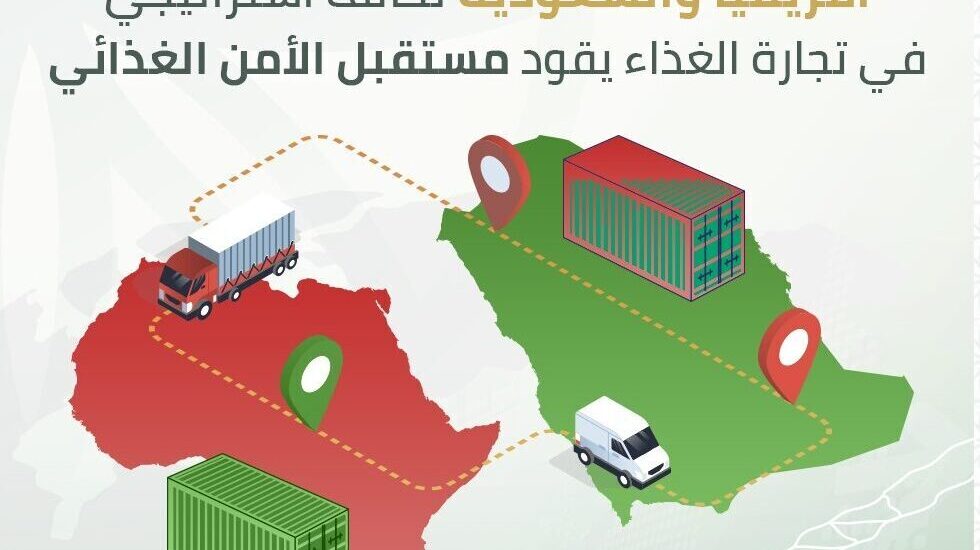
1- The reality of food and beverages in Africa: increasing demand and developing economies
Africa, with a population of over 1.4 billion, is experiencing rapid demographic growth and urban expansion, with rising incomes. These changes drive demand for a variety of foods and beverages such as dairy, processed foods, beverages, grains and meat.
However, trade within the continent remains limited, and many countries depend on imports to meet consumption, opening up export opportunities from the Middle East, Asia, and Europe
- Saudi Arabia’s food export strategy: from self-sufficiency to global supply
2.1 Achieving food security and enhancing export capacity
The Kingdom has invested in achieving food self-sufficiency: in 2023, it reached 119% in dates, 129% in dairy products, and 147% in shrimp, reflecting excess export readiness
SALIC has acquired a $1.24 billion stake in Olam Agri, giving the kingdom access to grain and oil supply chains across Asia and Africa
2.2 Saudi brands with export experience
Nadec produces more than 1.5 million liters of dairy per day, exporting to customers in the Middle East and North Africa
As for Savola Group, it is the largest food company in the Kingdom, with a strong stake in Egypt and extensive regional distribution
- Trade with Africa: key trends and sectors
3.1 Increase export volume
Saudi Arabia’s exports to Africa amounted to about 1.6 billion riyals in December 2024, up from 1.07 billion riyals in November, and peaked in October 2022 at 3.89 billion riyals
Food and beverages are an important part of this, especially dairy products, juices, oils, and processed foods.
3.2 Example: Exports to Somalia
In 2019, Somalia imported $49.8 million worth of food products from Saudi Arabia, including $16.7 million worth of concentrated milk, $5.13 million worth of juices, and $6.7 million worth of tropical fruits
- Sectors Opportunities for Saudi Arabia in Africa
4.1 Dairy and juices
High-quality, halal-certified dairy meets a wide range of needs in Africa, especially in countries with limited cold infrastructure.
4.2 Processed foods and snacks
With urban expansion, the demand for prepared foods grows. Companies like Nadec and Savola have a strong distribution structure that covers these precautions.
4.3 Non-alcoholic beverages
Drinks such as malted barley and healthy juices are expanding among young people, representing an untapped opportunity for Saudi brands.
4.4 Grains and oils
Through SALIC and Olam Agri, Saudi Arabia can now export grains and food oils to African countries that depend on imports.
- Saudi–African agricultural partnerships
5.1 Investments and development funds
– SALIC’s $1.24 billion investment in Olam Agri boosts agricultural supply to Africa
The Saudi Development Fund has financed more than 38 billion riyals ($10 billion) for more than 46 African countries
5.2 Transfer of knowledge and technology
Cooperation with African countries is underway to introduce advanced agricultural technologies and methods, opening new markets for Saudi products and services.
- Why Saudi food exports are desirable in Africa
– Halal: a decisive adoption by Muslim majority countries.
– Quality and continuity: strict food safety standards.
– Geographical proximity: Shortens shipping time and cost compared to Asian and European states.
– Official support: through export policies and investment programmes.
– Visual tags: Nadec and Savola are already present in African markets.
- Challenges and competitors
– Competition from India, Turkey, China, UAE and EU, especially in low-cost commodities.
– The existence of customs duties and regulatory requirements that differ between countries.
– The development of domestic production through African agreements such as AfCFTA may reduce external dependence over time.
- Strategic recommendations for Saudi exporters
– Focus on high-demand markets such as Nigeria, Kenya, Egypt, Ghana, and Somalia.
– Establish local partnerships with distributors and traders to customize products according to local taste and price.
– Exploit bilateral agreements and SALIC initiatives to reduce risks.
– Participate in exhibitions such as African Food Expo and In Flavor to ensure a presence in the Arabian Businesslucidityinsights.com market.
- Compatibility with Vision 2030
Vision 2030 dreams of diversifying the economy, increasing non-oil exports, and strengthening food security. The food and beverage sector occupies a strategic position in this transformation.
Africa’s rising food demand is in line with the Kingdom’s capabilities, providing opportunities to expand its export ambitions.
Conclusion
Africa offers promising opportunities for Saudi food and beverage exports. Demand is growing in conjunction with population transformation and high income. The Kingdom has the formal manufacturing capacity, trademarks and government policies necessary for effective positioning in African markets. Through market allocation, partnerships, and thoughtful marketing moves, Saudi exporters can contribute to African food security while achieving sustainable growth.
How can we help you?
Contact us at the Consulting WP office nearest to you or submit a business inquiry online.